
Hydraulic cylinders & lifts / POSITION FEEDBACK
Draw-Wire Position Sensors for Hydraulic Cylinders & Lifts
External rod travel, forklift carriage position and platform height are different measurements. Start with the actual cable path and controller input.
Prepare this application enquiry ↗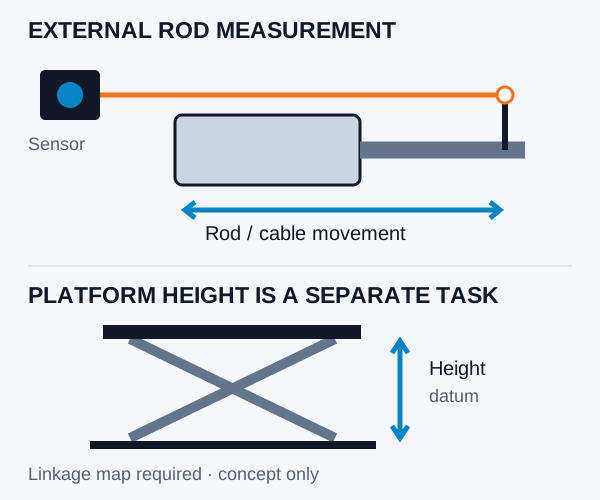
ROD TRAVEL ≠ PLATFORM HEIGHT
Which displacement does the controller need?
| Moving point | What the cable can measure | What still needs verification |
|---|---|---|
| Cylinder rod | External rod displacement when the cable axis and fixed/moving anchors are appropriate. | Articulation, side pull, guards, end reserves and the actual cable-to-rod relationship. |
| Forklift carriage / mast | Travel between the chosen mast and carriage anchors. | Chains, staged mast movement, changing cable routes and the required lift-height datum. |
| Scissor platform | Direct platform displacement if the measurement path follows the required height. | A sensor on the cylinder may have a nonlinear relationship to platform height; provide the linkage map. |
A change in cable angle changes the relationship between target motion and cable extension. Check the entire movement envelope, including steering, pivoting and tilted structures. A mounting drawing with both anchor positions is more useful than the nominal cylinder stroke alone.
Micro-Epsilon: synchronized lifting example — An external manufacturer example of cable-based position feedback in a lifting system; it does not validate a DWP synchronization or accuracy claim. Third-party specifications apply to their own devices.
External mounting and pressure-rated integration are separate designs.
External cylinder or lift installation
Locate the sensor body outside the pressure envelope. Check the cable path for pinch points, collision, moving hoses, debris and unsupported return. Agree cable exit alignment, the mounting face and retraction duty before fixing the enclosure.
Inside the cylinder
Pressure-boundary integration requires a purpose-designed mechanism, seals, materials and validated cylinder interface. The DWP family selection envelopes do not establish pressure resistance or in-cylinder suitability.
SIKO: purpose-designed in-cylinder position sensors — This illustrates why cylinder integration is a distinct product design, with product-specific pressure and durability validation. Third-party specifications apply to their own devices.
Connect the measured travel to the correct PLC input.
4–20 mA / voltage input
Start with DWP-POS for an analog request. Identify the input card, active/passive loop topology, supply, scaling and required channel error. Current and voltage transmitters use different circuits.
Review analog position sensors →Pulse / absolute position
Start with DWP-ENC when the controller expects counts or a defined bus value. Specify count scale, cycle time, reference recovery and behavior after power loss. Confirm exact protocol availability.
Review draw-wire encoders →A panel readout can provide an indication channel where suitable. Its high/low process relays do not establish a safety limit system. Synchronizing multiple axes or preventing overtravel requires machine-level control validation.
Check functional wiring and commissioning →Hydraulic cylinders & lifts / REQUEST INPUTS
Bring these three details to the selection review.
Measured point / cylinder or lift geometry
Rod, carriage or platform? Describe the moving and fixed anchors and any linkage ratio.
External mounting and exposure
Bracket clearance, protective guarding, moving hoses, rod rotation, oil or mud splash, washdown and temperature.
Controller and motion duty
PLC/input card, peak speed, acceleration, cycle rate and restart requirements.
The enquiry opens with this application profile and three matching questions. Your answers remain in the form and enquiry text; they are not added to the website’s page address.
Request an application review ↗Stroke mapping, pressure and travel limits
Can one sensor measure both cylinder stroke and platform height?
Only when the mechanical mapping between the two is defined and validated. A direct height measurement can avoid relying on cylinder linkage geometry, but it introduces its own cable-routing and mounting requirements.
Is a draw-wire sensor pressure-rated for an in-cylinder installation?
That must be established for the exact design. An external sensor selection envelope and enclosure rating do not establish a pressure boundary or compatibility with hydraulic fluid.
Can the readout relay replace the machine travel limits?
A general process relay does not establish a machine safety function. Provide the control architecture and required validation separately from the position-indication request.
Engineering guidance reviewed November 3, 2026. Original diagrams and calculations describe principles; performance and suitability require the selected model and installation to be checked.