
Suspension & vehicle testing / POSITION FEEDBACK
String Potentiometers for Suspension & Vehicle Testing
Capture suspension, pedal or fixture displacement with a defined motion map and a sensor/DAQ channel checked for the actual dynamic duty.
Prepare this application enquiry ↗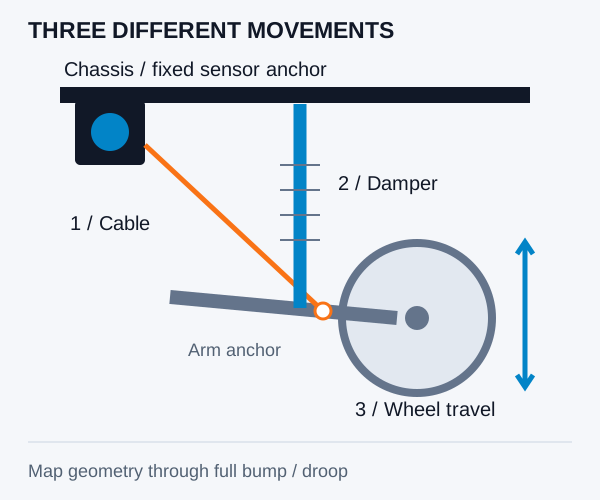
BUMP / DROOP / ATTACHMENT POINT
Cable extension is not automatically wheel or damper travel.
Map both anchors through the motion
A string pot measures the length of its cable path. When a suspension arm rotates, the distance between its anchor and the sensor changes with geometry. Damper motion and vertical wheel travel can each follow a different relationship.
For a straight free cable between fixed point P and moving point Q, path length is |Q − P|. Convert that length to the required quantity using a validated coordinate or linkage map. Do not assume a constant ratio across full bump and droop.
Keep both ends inside the usable window
Set the neutral position with enough pre-extension for droop and enough remaining travel for bump, plus the model-specific end reserves. Check steering lock, articulation, tire clearance and the complete return path.
Specify the cable excursion as well as the desired wheel/damper travel. A 50-inch request is 1,270 mm; 1,250 mm is 49.213 inches.
UniMeasure: displacement sensor selection guide — The original supplier distinguishes application and product families, including suspension and other vehicle tests; application names alone do not qualify dynamic performance. Third-party specifications apply to their own devices.
CABLE MOTION / IDEAL SINUSOID
A short stroke can still require high cable acceleration.
For cable extension x(t) = x₀ + A sin(2πft), enter the amplitude of the cable motion about its mean. Wheel amplitude is usable only after validating its map to cable extension.
Excursion = 2A; peak speed = 2πfA; peak acceleration = (2πf)²A. Length is converted to meters for speed and acceleration. Input limits are calculator bounds, not product ratings.
These are separate maxima within a sinusoidal cycle. Allow preload and end reserves around the mean extension x₀. Retraction tension, acceleration, bandwidth and cycle life need selected-device validation. If the mechanism cannot track the return motion, cable slack can distort the measurement. Non-sinusoidal road or crash traces need their actual peak duty reviewed.
Review the mechanics and DAQ channel together.
| Channel element | Selection question | Bring to the review |
|---|---|---|
| Cable / spring / moving attachment | Can the mechanism track the actual speed, acceleration and cyclic reversals while maintaining tension? | Motion time trace, cycle rate, cable path and attachment details. |
| Potentiometer divider | Are excitation and input impedance suitable for the allowable loading error? | Track resistance, excitation, DAQ input specification and grounding. |
| Transmitter / encoder | Do output bandwidth, update rate and controller acquisition meet the test requirement? | Selected interface, signal conditioning, counters or bus timing. |
| DAQ / reference channel | Are sampling, filtering and time alignment adequate for the waveform and required uncertainty? | DAQ model, filter settings, synchronization and reference method. |
Sampling rate by itself does not establish usable measurement bandwidth or system accuracy. Repeated road inputs and crash pulses are different duty cases; a compact enclosure or static stroke match does not prove suitability for either.
Micro-Epsilon: draw-wire sensors for fast measurements — The manufacturer provides dedicated fast-motion sensor families, reinforcing the need to check mechanism dynamics separately from travel. Third-party specifications apply to their own devices.
Check divider wiring and receiver loading →Suspension & vehicle testing / REQUEST INPUTS
Bring these three details to the selection review.
Cable / damper / wheel measurement map
Which physical displacement is required? Give anchor coordinates or a linkage drawing.
Bump / droop and dynamic test duty
Total cable excursion, preload, peak speed/acceleration, frequency or time trace and duty cycle.
DAQ, excitation and bandwidth
Input model, divider excitation or transmitter input, sampling/filtering, synchronization and required error.
The enquiry opens with this application profile and three matching questions. Your answers remain in the form and enquiry text; they are not added to the website’s page address.
Request an application review ↗Geometry, dynamic duty and channel accuracy
Does a compact string pot qualify for crash testing?
Size and stroke alone do not qualify it. Provide the actual velocity/acceleration trace, transient duration, cable route, bandwidth and required test evidence for a separate review.
Can I use wheel travel as cable amplitude in the calculator?
Only if the geometry has already established that relationship for the movement. Otherwise use the mapped cable excursion or the measured cable time trace.
Does a digital display improve suspension measurement accuracy?
Display digits do not improve the sensor or DAQ error budget. Dynamic tests also require suitable channel bandwidth and synchronization.
Engineering guidance reviewed November 3, 2026. Original diagrams and calculations describe principles; performance and suitability require the selected model and installation to be checked.